

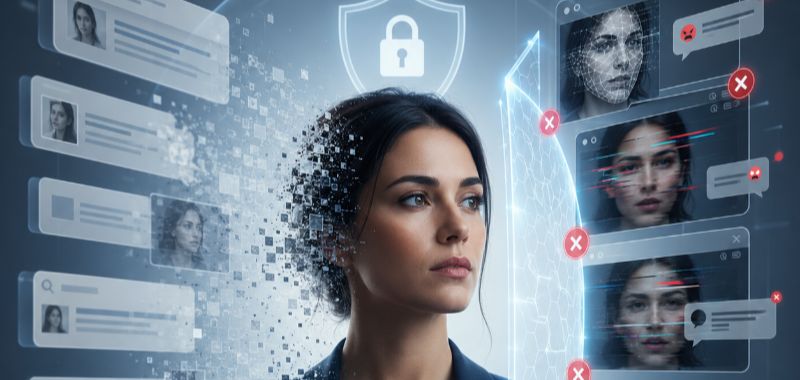
The updating of the right to honour in the digital era
In this context of increasing digitalization, the way in which personal reputation is built, disseminated and protected has undergone a transformation. The right to honor, traditionally linked to protection against insults or defamation in physical media, now faces far more complex challenges. Instant virality, content manipulation and the almost indefinite permanence of information have become common problems.
Deepfakes and defamatory comments: what legal actions are available to you
One of the most concerning phenomena today is the use of artificial intelligence tools to generate highly realistic false content, known as deepfakes. These may consist of manipulated videos, audio recordings or images that attribute to a person conduct or statements they never made, thereby affecting their reputation.
From a legal perspective, several courses of action are available in response to this type of conduct. In the civil sphere, the affected person may bring a claim for unlawful interference with their honor, pursuant to Organic Law 1/1982. This route allows the claimant to request, on the one hand, the cessation of dissemination and removal of the content and, on the other hand, compensation for damages.
In the criminal sphere, certain deepfakes or defamatory comments may constitute offences of insult or slander, as regulated in the Spanish Criminal Code. In such cases, criminal proceedings may lead to financial penalties and even criminal liability for the perpetrator.
Furthermore, although in many cases they act as intermediaries, it is important to consider the responsibility of the digital platforms that host this content, as they may be required to remove unlawful content once they have effective knowledge of its existence.
How to exercise the right to be forgotten before Google and other platforms
The right to be forgotten constitutes a manifestation of the right to erasure in the context of search engines and digital platforms. It allows the dissemination of personal data to be limited when such data is no longer adequate, relevant or pertinent.
It enables the data subject to request the de-indexing of information from search engines or the removal of content from platforms and social media, even where such content was lawfully published, if it has become obsolete or has lost public interest.
To do so, it is necessary to submit a request through the forms made available by the relevant company or platform, explaining why the information is inadequate, irrelevant, outdated or excessive considering the time elapsed or the applicable public interest.
If the request is rejected, the affected person may refer the matter to the Spanish Data Protection Agency, which acts as the supervisory authority. This body may assess the case and, where appropriate, order the removal of the links or impose sanctions on entities that fail to comply with the applicable regulations.
However, although legal remedies are available, it should be noted that the right to be forgotten is not absolute. There may be cases where a relevant public interest exists, such as information concerning public officials or recent criminally relevant facts, in which case the right to information may prevail.
When to report and through which route: civil, criminal or before the Spanish Data Protection Agency
The main question that arises when several courses of action are available is determining which is the most appropriate in each case. The choice depends on various factors, such as the seriousness of the infringement, the author’s intent, the type of content and the objective pursued by the affected person.
The civil route is generally the most used in matters concerning the right to honor. It is the most appropriate option where the aim is to have the content removed, obtain a correction or secure financial compensation. Its main advantage is that it does not require proof of malicious intent, which makes it easier to use in cases involving negligent or irresponsible dissemination.
The criminal route, by contrast, is reserved for the most serious cases, particularly where there is a clear intention to damage reputation through false accusations or serious insults. Although it may have a stronger deterrent effect, its main drawback is that it involves a more complex procedure with a higher evidentiary threshold.
Finally, the involvement of the Spanish Data Protection Agency is particularly useful in matters relating to personal data, such as the right to be forgotten or the unauthorized disclosure of private information. This is an administrative route and may be more agile in certain cases, although it does not always allow direct compensation to be obtained.
It is important to highlight that, in practice, these routes are not mutually exclusive. In other words, it is possible to request the removal of content from a platform, refer the matter to the Spanish Data Protection Agency if no response is obtained and, in parallel, initiate civil or criminal proceedings against the responsible party.

María Barbero es abogada especializada en derecho digital, derecho de las nuevas tecnologías y emprendimiento tecnológico.
Graduada en Derecho y Relaciones Internacionales por la Universidad Europea de Madrid, amplió su formación con un doble máster en acceso a la abogacía, emprendimiento y tecnología en IE University. Enfocada en la actualización constante, aporta una visión jurídica adaptada a la evolución digital. Habla español e inglés.
More from my site
 Ley de Protección de Datos ¿En qué consiste y cómo te afecta?
 La Mafia se Sienta a la Mesa
 ¿Necesito una Evaluación de Impacto antes de implantar una herramienta de IA en mi empresa?
 Regulation of the activity and operation of the Co-Investment Fund
 Proyecto de Ley de Reforma de la Ley de Enjuiciamiento Civil
 Ley de Protección de Datos Brasil: Un panorama general de la nueva legislación